

The oil market opened the week on a sharply bullish footing as escalating tensions in the Middle East rattled global supply expectations. Initial concerns mounted rapidly following news that crude loadings at Saudi Arabia’s Red Sea export hub in Yanbu were suspended after damage to the East-West pipeline caused by drone strikes. The surrounding uncertainty regarding repair timelines drove risk premiums significantly higher, pushing benchmark prices near four-month highs as markets attempted to price in potential long-term disruptions to primary Saudi export infrastructure.
By midweek, the aggressive price rally began to lose momentum as active supply-mitigation strategies took effect across physical trading routes. Saudi Arabia initiated alternative export mechanisms, including ship-to-ship transfers off Oman’s Sohar port and temporary shuttle shipments through the Strait of Hormuz to bypass domestic logistics bottlenecks. Concurrently, diplomatic efforts intensified, with Chinese officials urging restraint and calling for the reopening of key maritime transit channels, which helped temper fears of immediate, unmanageable supply shortfalls.
Heading into Thursday, cross-border military exchanges between Saudi Arabia and Houthi forces in Yemen expanded the regional conflict footprint, rekindling security worries around the Bab el-Mandeb Strait. However, these geopolitical risks were largely counterbalanced by reports that Saudi Arabia was already making progress toward restoring roughly half of its East-West pipeline capacity within days, substantially easing fears of prolonged export curtailments.
By the end of the week, crude prices closed lower to mark a third consecutive session of declines as supply recovery hopes outweighed broader tension. Reports confirmed that partial restoration of the East-West pipeline was progressing toward half capacity, with full operations targeted within six weeks. Downside pressure was further reinforced by global inventory builds, including a 3.7 million barrel increase in refined product stocks across the U.S., Europe, and Singapore, alongside a 12.7% year-on-year surge in Chinese refined oil product exports.
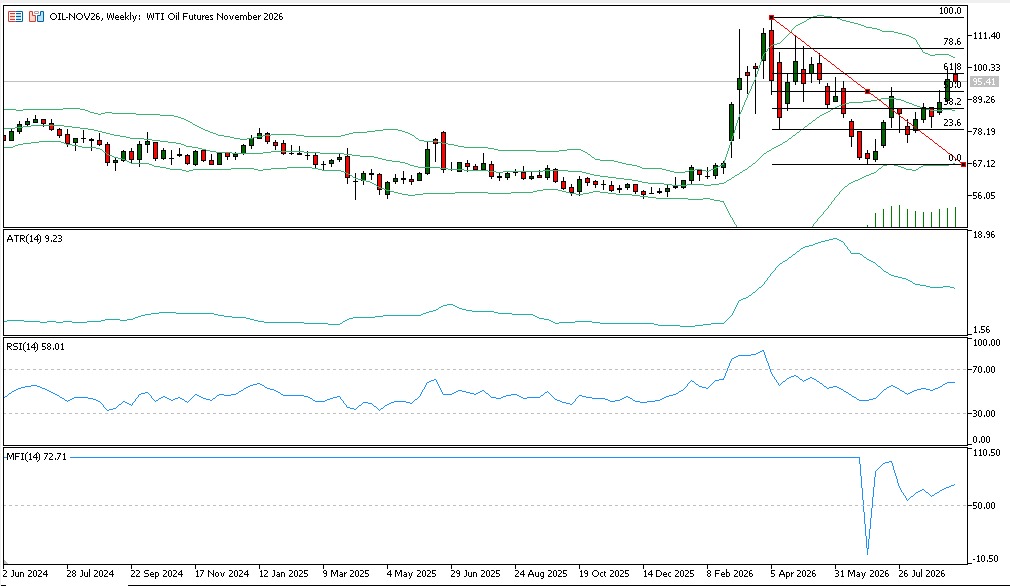
From a technical perspective, WTI crude oil ($100.76) is consolidating inside a symmetric wedge pattern following its peak at $107.73, with contracting 20-period Bollinger Bands and a declining ATR of 1.57 signaling a volatility squeeze. Price is holding near the middle band at $100.70—aligned with the 23.6% Fibonacci retracement level at $100.67 where a breakout above the upper band ($103.11) or breakdown below the lower band ($98.49) will dictate the next directional move. Resistance sits at the 50.0% ($103.11) and 61.8% ($104.20) Fibonacci levels, with a break higher targeting the $107.73 peak, while key support holds at the 0.0% Fibonacci floor ($98.49), below which lies $93.87. Momentum remains neutral-to-oversold, as the 14-period RSI sits at 46.91 and the Money Flow Index (MFI) rests at 20.72 in deep oversold territory, indicating selling exhaustion and potential for a relief bounce off the $98.49–$100.67 support zone.