

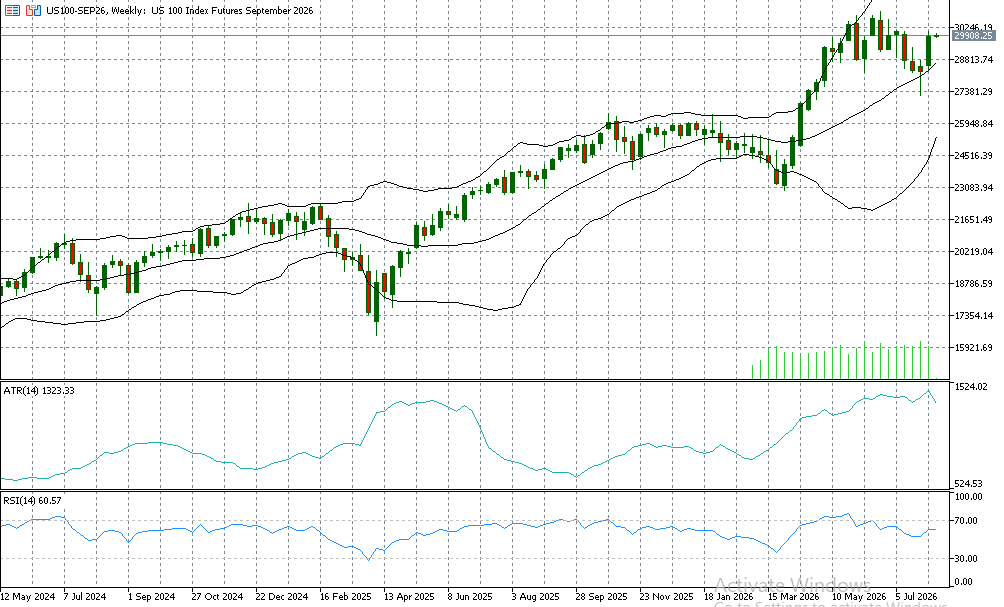
US stock index futures traded largely flat on Sunday as investors adopted a cautious stance following renewed uncertainty over the reopening of the Strait of Hormuz. Concerns that prolonged restrictions on the key energy route could keep oil prices elevated and add to global inflationary pressures weighed on sentiment ahead of a busy week for US economic data and corporate earnings. S&P 500 futures edged lower, while Nasdaq 100 and Dow Jones futures remained broadly subdued. The cautious tone followed comments from Iranian Foreign Minister Abbas Araghchi, who said that an agreement with Oman to establish alternative shipping lanes through the Strait of Hormuz was nearing completion. However, Tehran indicated that the arrangement alone would not be sufficient to fully reopen the waterway.
Iran has reportedly demanded several conditions, including compensation from the United States, an end to military threats and sanctions, and the lifting of the naval blockade. The demands have reduced expectations of an immediate normalization of commercial shipping through one of the world’s most important oil transit routes. The Strait of Hormuz remains critical for global energy markets, with a significant share of global crude shipments passing through the waterway. Any prolonged disruption could keep oil prices elevated, increasing transportation and production costs while placing renewed pressure on global inflation. Higher energy prices could also complicate the Federal Reserve’s monetary policy outlook if they translate into persistent increases in consumer and producer prices.
However, Washington has indicated that progress toward an Iran-Oman shipping arrangement could allow the US to lift restrictions on Iranian ports once commercial traffic can resume safely. The possibility of a diplomatic solution has therefore prevented a sharper deterioration in global risk sentiment. Wall Street enters the new week following a strong performance in the previous session. US equities rallied after July employment data showed the economy lost 23,000 jobs, significantly weaker than expectations for an increase of around 80,000. The softer labor market report reduced expectations of an imminent Federal Reserve rate hike and pushed US Treasury yields lower.
The Dow Jones Industrial Average gained 0.3%, while the S&P 500 advanced 0.6% to a record closing level. The Nasdaq Composite outperformed with a 1.3% gain, supported by renewed demand for technology stocks. On a weekly basis, the S&P 500 rose 3.6%, the Nasdaq climbed 5.2%, and the Dow added 3%. The weaker employment data has strengthened expectations that the Federal Reserve could maintain a less restrictive policy stance if inflation continues to moderate. However, policymakers are likely to remain cautious because a sustained increase in energy prices could reverse some of the recent progress on inflation.
Federal Reserve officials continue to emphasize that future interest-rate decisions will depend on incoming economic data. Investors will therefore focus heavily on Wednesday’s US Consumer Price Index report for further evidence regarding inflation trends and the potential timing of future policy adjustments. Corporate earnings will also remain in focus, with investors monitoring results from major companies including Applied Materials, Cisco Systems, and CoreWeave. With nearly 90% of S&P 500 companies having reported quarterly results and approximately 76% exceeding earnings expectations, resilient corporate performance continues to provide support for equity valuations. Looking ahead, developments surrounding the Strait of Hormuz, oil prices, US inflation data, and Federal Reserve expectations are likely to determine the direction of financial markets. While strong corporate earnings and softer labor market conditions remain supportive for equities, renewed energy price pressures could create a significant risk for the current market rally.