
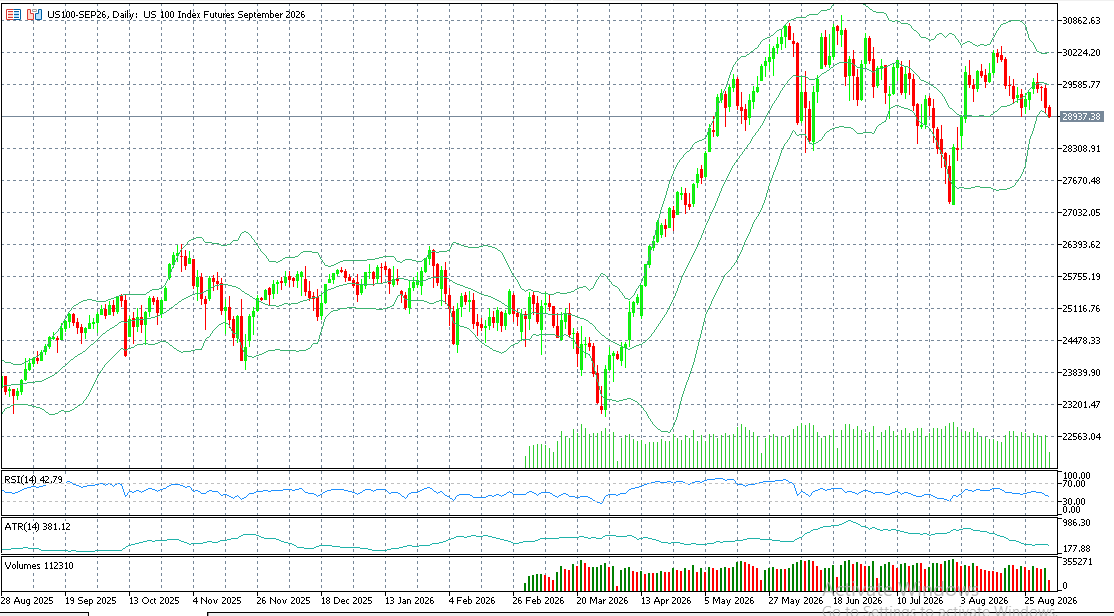
U.S. stock index futures moved lower on Wednesday as investors remained cautious amid a sharp sell-off in global government bonds, elevated oil prices, and growing expectations that the Federal Reserve could raise interest rates later this month. S&P 500 futures declined 0.2% to around 7,610, while Nasdaq 100 futures fell 0.4% to 29,003, with rate-sensitive technology stocks leading the decline. Dow Jones futures were broadly unchanged at approximately 52,797.
The softer futures tone followed a volatile session on Tuesday, when the S&P 500 lost 0.7%, the Nasdaq Composite declined 1%, and the Dow Jones fell 0.8%. The declines came despite stronger-than-expected August manufacturing PMI data, which failed to improve investor sentiment. The major source of pressure across global markets remains the aggressive sell-off in government bonds, which has driven benchmark borrowing costs to multi-year and multi-decade highs.
In the U.S., the two-year Treasury yield traded around 4.354%, its highest level since 2025. The 10-year Treasury yield climbed to 4.780%, while the 30-year yield reached 5.273%. Higher Treasury yields are weighing on equities through several channels. Since institutional investors value companies by discounting their expected future cash flows, higher risk-free rates increase the discount rate and reduce the present value of future earnings. This effect is particularly significant for high-duration sectors such as technology, software, and semiconductors.
At the same time, elevated government bond yields make relatively safe fixed-income investments more attractive compared with equities. As the expected premium for taking equity risk declines, institutional investors may reduce stock allocations. Rising long-term borrowing costs are also increasing financing, capital expenditure, and refinancing expenses for companies, potentially putting additional pressure on corporate profitability as the year moves toward its final quarter.
Investor sentiment was further undermined by another round of U.S. military strikes against targets associated with Iran’s Islamic Revolutionary Guard Corps in the Persian Gulf. Iran subsequently launched missile attacks against U.S. military facilities in several Gulf countries, while commercial shipping through the Strait of Hormuz remained severely disrupted. Maritime tracking data indicated that traffic through the strategic shipping route had fallen sharply compared with normal levels.
The risk of further escalation has kept crude oil prices above $90 a barrel. Concerns that prolonged disruption to energy supplies could push fuel and other costs higher have renewed fears of cost-push inflation, complicating the outlook for monetary policy. Persistent inflation concerns driven by higher energy prices, combined with hawkish signals from central bank officials, have led markets to significantly increase expectations for further monetary tightening.
According to CME FedWatch, markets were pricing in a 67.9% probability of a 25-basis-point Fed rate hike at the September 16 meeting, up substantially from 34.7% a week earlier. The reprising followed comments from Fed Chair Kevin Warsh at Jackson Hole indicating that policymakers still had further work to do to bring inflation under control.
Investors are now turning their attention to a series of U.S. labor-market indicators to assess whether economic conditions justify the Fed’s more hawkish stance. Tuesday’s July JOLTS report showed job openings increasing from the previous month, despite coming slightly below expectations, suggesting that underlying labor demand remains relatively resilient.
The market’s immediate focus is now on Friday’s August Nonfarm Payrolls (NFP) report, followed by next week’s August CPI inflation data. Both releases are expected to play an important role in shaping expectations ahead of the Fed’s September FOMC meeting.