
The international silver price is hovering in a delicate holding pattern near $75.75 per troy ounce as a dense mix of fragile diplomatic negotiations, escalating Middle Eastern military actions, and high-stakes economic data keep market participants heavily guarded. The precious metal is locked in a tug-of-war stemming from the highly fluid communication between Washington and Tehran over a permanent peace deal. While United States President Donald Trump signaled that Iran is eager to finalize an accord, he explicitly warned that military options remain live. The White House continues to demand the total destruction of Iran’s nuclear infrastructure and the verified removal of all highly enriched uranium as strict prerequisites for peace. Concurrently, Iranian Foreign Minister Abbas Araghchi confirmed that discrete message exchanges remain active but dismissed current media commentary as premature speculation, while Parliament Speaker Mohammad Bagher Ghalibaf established a firm boundary by vowing to reject any framework that fails to secure the sovereign rights of the Iranian people.
This diplomatic impasse is further complicated by a volatile security situation on the ground that threatens to unravel broader regional stability. Despite a six-week-old ceasefire, Israel recently ordered its military forces to advance deeper into Lebanon to counter the Iran-backed militant group Hezbollah, triggering a sharp counter-rally in crude oil prices over renewed energy supply anxieties. This resurgence in energy costs directly pressures silver due to the well-documented inverse relationship between precious metals and oil during times of conflict. Elevated energy prices act as a direct driver of global inflation, keeping pressure on recent U.S. Personal Consumption Expenditures data and forcing major central bank figures, including leadership at the Kansas City Federal Reserve, to maintain a distinctly restrictive policy tone. Because silver is a non-yielding asset, the prospect of higher-for-longer interest rates significantly elevates the opportunity cost of holding physical bullion compared to yield-bearing U.S. Treasuries, effectively capping any immediate geopolitical risk premium.
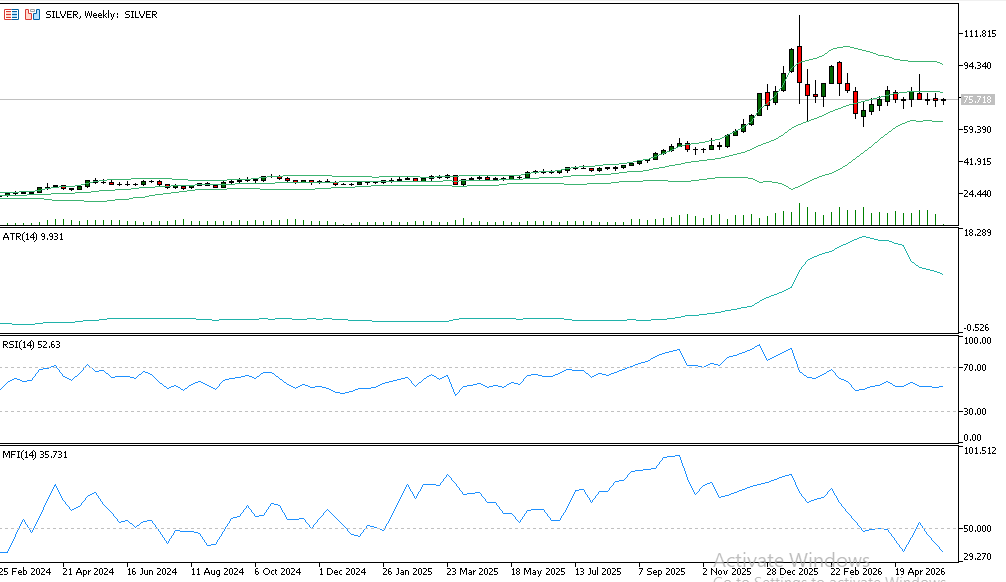
From a purely technical vantage point, the silver market is trapped within a well-defined horizontal consolidation range bounded by $71.79 on the bottom and $78.83 on the top. The broader near-term bias remains heavily subdued because the metal continues to trade underneath its 20-day exponential moving average of $76.92, while a Relative Strength Index reading of 47 confirms a lack of upward momentum. For the bulls to regain control and stage a meaningful recovery toward the mid-month peak of $83.88, they must first clear the immediate psychological barrier at $78.83. Conversely, a failure to sustain the current floor could trigger a technical slide past the May support level of $71.79, exposing deeper structural support targets near $68.28 and ultimately the major multi-month psychological bottom down at $61.01.
Beyond paper market technicals and the headline-driven geopolitical landscape, silver’s underlying value is being heavily anchored by a historic supply squeeze in physical markets that went unmentioned in early regional reports. Driven by the global green energy transition and surging solar panel manufacturing, industrial demand has triggered massive physical drawdowns, highlighted by China’s silver imports exploding to a record-shattering 836 metric tonnes in a single month. This physical deficit is keeping a firm floor under the market as traders avoid taking large directional positions ahead of the upcoming U.S. Nonfarm Payrolls data for May. A hot labor report would grant the Federal Reserve license to remain restrictive and likely force silver down to test its range limits, whereas an economic slowdown in the data would revive rate-cut optimism and potentially provide the macroeconomic spark required to break through overhead resistance.