
Platinum prices have come under renewed pressure, with futures falling below $1,560 per ounce and reaching their lowest level since November 2025. On October 26, prices traded near $1,550 per ounce, reflecting persistent weakness across the precious metals market. The decline highlights growing investor caution amid financial market volatility, inflation concerns, and weakening investment demand.
One of the key drivers behind platinum’s decline has been a broader sell-off in global equities. Concerns about the sustainability of heavy investment in artificial intelligence have unsettled investors and contributed to losses in technology stocks. As investors faced losses elsewhere, some liquidated precious metals and other marketable assets to meet margin calls and raise cash, adding further selling pressure to platinum.
Rising oil prices and escalating Middle East tensions have added to inflation concerns, increasing expectations that interest rates could remain elevated for longer. Higher interest rates and Treasury yields generally reduce the attractiveness of platinum because it does not generate interest income. Investors may prefer interest-bearing assets when bond yields are high, placing additional pressure on precious metals. Markets are closely monitoring the Federal Reserve’s October 27–28 meeting for signals about the future direction of monetary policy.
Fundamental supply-and-demand conditions are also weighing on platinum. The World Platinum Investment Council (WPIC) forecasts a global market surplus of 265,000 ounces in 2026, reversing its earlier deficit outlook. The shift mainly reflects weaker investment demand, substantial ETF outflows, and increased recycling supply. The WPIC expects total supply to rise by 2% to 7.353 million ounces, while total demand is projected to fall by 18% to 7.089 million ounces.
Jewellery consumption remains another major concern, particularly in China, one of the world’s key platinum markets. The WPIC expects global platinum jewellery demand to decline by 15% in 2026, with higher prices and subdued consumer spending weighing on purchases. Investment demand has also weakened as investors reduce exposure to precious metals amid economic uncertainty. These trends could limit the potential for a sustained recovery unless investor confidence and physical demand improve.
The outlook for platinum remains mixed across its major end-use industries. Automotive demand is forecast to decline by 4% in 2026, partly reflecting weaker vehicle production and changing regional demand patterns. However, industrial demand is expected to grow by 5%, supported by applications in glass manufacturing, chemicals, electronics, and AI-related infrastructure. This industrial growth could provide some support to prices, although it may not fully offset weakness in investment, jewellery, and automotive demand.
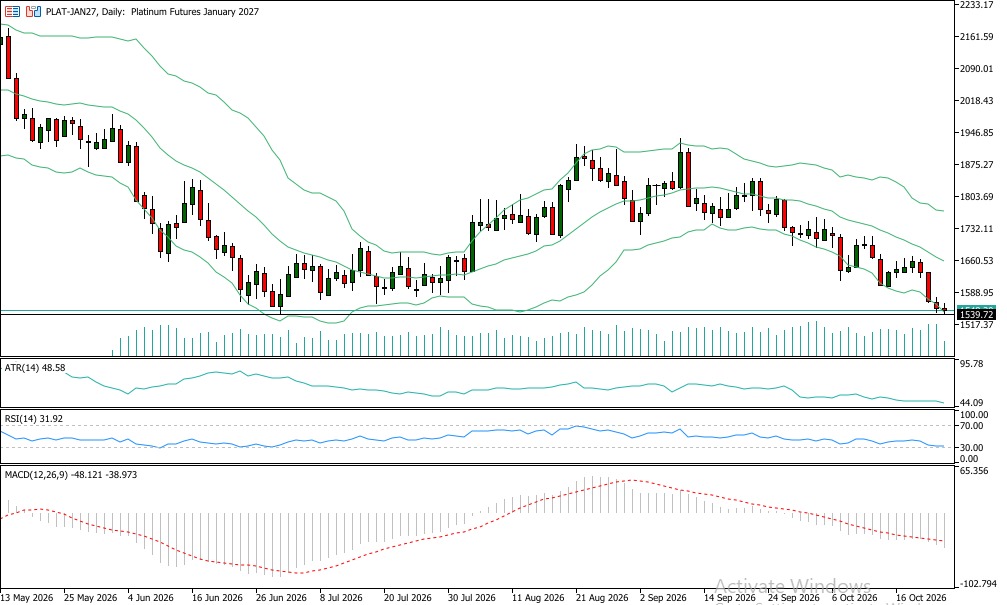
From a technical perspective, platinum remains under bearish pressure after falling below $1,560 per ounce. Recent price action indicates that sellers remain in control, while the market’s ability to hold near recent lows will be important in determining the next move. A sustained break below the recent trading low near $1,540 could expose the market to further downside, whereas a recovery above the $1,560–$1,580 zone may indicate improving short-term momentum. These are indicative levels based on recent futures prices, not confirmed support or resistance zones.
Overall, platinum faces near-term challenges from financial market volatility, higher-for-longer interest-rate expectations, and a projected supply surplus. However, exceptionally low above-ground inventories and anticipated industrial demand growth could help limit downside risks over the medium term.
Traders should monitor Federal Reserve signals, oil prices, the US dollar, investment flows, and key technical levels before taking positions.