

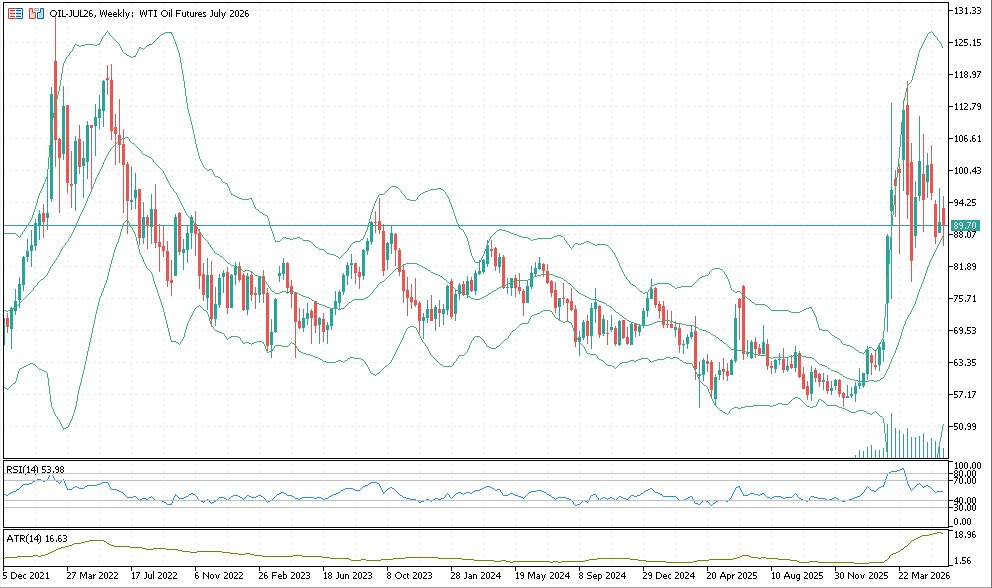
WTI crude oil futures fluctuated around the flat line on Wednesday, trading near $88.19 a barrel after gaining approximately 1% in early trading to reach $88.97. Despite a fresh round of military strikes between the United States and Iran, the West Texas Intermediate benchmark struggled to find sustained upward momentum, remaining down more than $4 for the week. The price volatility follows a major 3% drop in the previous session, which had pushed the U.S. benchmark to its weakest settlement since late May.
The geopolitical landscape worsened overnight following a breakdown in a fragile ceasefire. Iran’s Islamic Revolutionary Guards Corps announced it launched retaliatory missile strikes against U.S. military bases in Bahrain, Jordan, and Kuwait. Tehran claimed the attacks were in response to U.S. “self-defense” strikes targeting radar and air defense systems in Southern Iran, which Washington executed after an American Apache attack helicopter was downed by an Iranian drone. Complicating matters, Israel simultaneously pressed forward with military operations in Southern Lebanon against Iran-backed Hezbollah militants, leading to reports of multiple casualties.
The escalation directly challenges recent efforts by U.S. President Donald Trump to convert a temporary truce into a permanent peace deal. Reacting to the overnight hostilities, President Trump issued a stern warning directly to Iranian leadership on his Truth Social platform, stating: “The Bully of the Middle East is DEAD!!! They’ve taken too long to negotiate a deal that would have been great for them, now they will have to pay the price!!!”The ongoing conflict continues to choke the Strait of Hormuz, where Iran has blocked the majority of commercial shipping through a waterway that typically facilitates a fifth of global crude oil. Newly released market data underscores the gravity of the blockade, revealing that the three-month conflict has officially erased a staggering 1 billion barrels of cumulative crude supply from global markets, making it the most severe supply disruption in modern history. Despite the gridlock, domestic leadership suggests an eventual turnaround. U.S. Energy Secretary Chris Wright noted that while it may take many months for global energy flows to completely normalize, vessel traffic in the Gulf and oil exports through the Strait are actively rising.
Even with daily price fluctuations, WTI crude remains elevated well above its pre-war baseline. This prolonged premium has kept global central banks on high alert over energy-driven inflation, making upcoming U.S. Consumer Price Index (CPI) data critical for projections on interest rates. Limiting the downside for WTI is a compounding domestic and global supply squeeze. Industry data from the American Petroleum Institute revealed that U.S. crude inventories plummeted by 9.12 million barrels last week—far exceeding the forecasted 3.4 million-barrel decline and dragging commercial reserves to some of their lowest levels since 2003. Gasoline stocks fell by 1.19 million barrels, while distillates saw a modest build of 1.32 million barrels. Traders are now awaiting the official weekly report from the U.S. Energy Information Administration (EIA). The government data is expected to confirm an eighth consecutive weekly drawdown. In its newly released Short-Term Energy Outlook, the EIA projects that the market will face extreme deficits due to the Hormuz closures, with global oil inventories expected to contract by a massive 6.3 million barrels per day through the current quarter, severely restricting supply heading into the peak summer months.