

Gold (XAU/USD) traded cautiously below the $4,350 level on Wednesday as investors remained reluctant to take large positions ahead of the Federal Reserve’s monetary policy announcement. The precious metal was last seen around $4,341.86, with a modest pullback in the US Dollar providing some support to Gold. However, this support was largely offset by a sharp increase in US Treasury yields, which raises the opportunity cost of holding non-yielding assets such as Gold. The Federal Reserve is widely expected to increase interest rates by 25 basis points at the conclusion of its meeting, making the accompanying guidance particularly important for financial markets. Investors are expected to closely examine the Fed’s updated economic projections and dot plot, while comments from Fed Chair Kevin Warsh could offer further clues about the pace and direction of future rate adjustments. A more hawkish policy outlook, particularly if officials signal that additional tightening may be required to contain inflation, could push Treasury yields and the US Dollar higher and create renewed pressure on Gold. Conversely, any indication that the Fed is becoming more cautious about further rate increases could weaken yields and the Dollar, potentially providing Gold with room to recover.
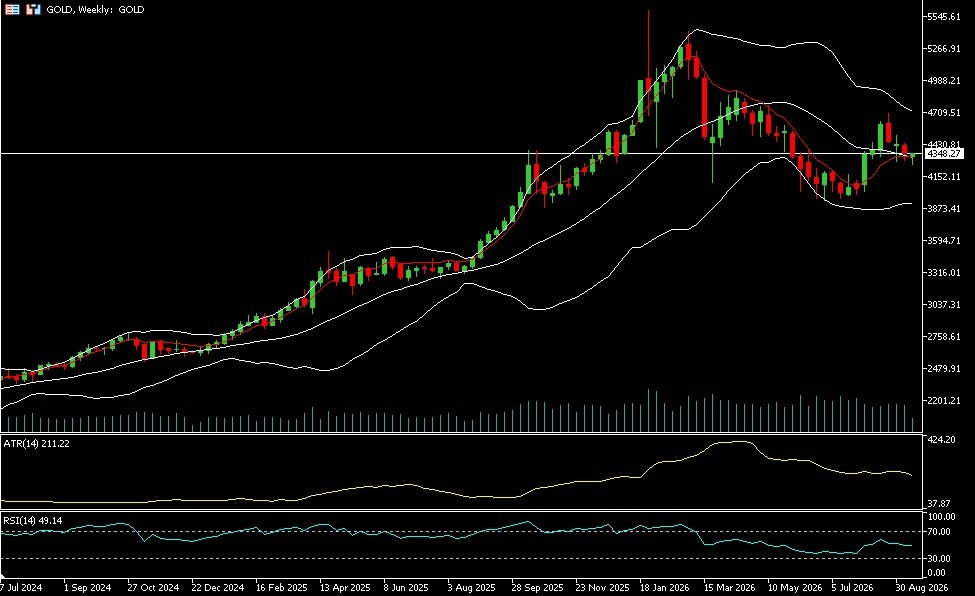
Beyond monetary policy, developments in the Middle East remain another important factor influencing Gold prices. Continued geopolitical tensions and the risk of disruptions to global Oil supplies are keeping investors alert to the possibility of higher energy prices and renewed inflationary pressures. Rising Oil prices can complicate the inflation outlook because higher energy costs can feed into transportation, production and consumer prices, potentially reducing the scope for central banks to ease monetary policy. This creates a mixed environment for Gold: geopolitical uncertainty and concerns over global supply disruptions can increase safe-haven demand for the precious metal, while higher inflation expectations can strengthen expectations for tighter monetary policy, which is generally less supportive for Gold. From a technical perspective, the daily chart shows Gold holding just above the 100-day simple moving average (SMA) at $4,326.81, indicating that buyers are still defending this area. Nevertheless, the metal remains below the 200-day SMA near $4,540.24, while the broader downward resistance structure continues to limit the recovery. The Relative Strength Index (RSI) around 48 also points to a lack of strong directional momentum, suggesting that the market is currently consolidating rather than following a decisive trend. On the upside, the 200-day SMA around $4,540.24 is the first major technical barrier, followed by horizontal resistance near $4,697.48. A sustained move above these levels would be required to improve the broader technical outlook.
On the downside, Gold has immediate support around the recent low of $4,253.78, and a decisive break below this level could increase selling pressure and expose the stronger horizontal support zone near $3,945. The one-hour chart presents a somewhat more constructive short-term picture, with Gold trading above the 100-period SMA around $4,324, while the RSI near 64 indicates that short-term bullish momentum is building. However, the recovery remains constrained by several closely positioned resistance levels. The descending trend line around $4,361 represents the first hurdle, followed by the 200-period SMA near $4,371. A firm break above this resistance area could strengthen the short-term bullish structure and potentially allow the metal to move toward the next horizontal barrier around $4,511. On the other hand, failure to clear the $4,361–$4,371 resistance zone could encourage renewed profit-taking and push prices back toward the $4,324 support area. Overall, Gold remains caught between competing forces, with safe-haven demand, geopolitical uncertainty and a softer US Dollar providing support, while elevated Treasury yields and expectations of further Federal Reserve tightening are limiting the upside. As a result, the Fed’s interest-rate decision, updated projections and forward guidance are likely to be the key catalysts determining whether Gold breaks higher from its current consolidation range or resumes its downward pressure.