

Gold (XAU/USD) came under renewed selling pressure following Federal Reserve Chair Kevin Warsh’s hawkish remarks at the Jackson Hole Symposium. His comments increased expectations that the Fed could consider another rate hike in September, particularly if inflation remains above the central bank’s 2% target. Higher interest-rate expectations generally weigh on gold because the precious metal does not generate interest income.
Warsh indicated that further monetary tightening could be required if inflation fails to move sustainably toward the Fed’s target. He also suggested that financial conditions are not sufficiently restrictive. These remarks strengthened the dollar and Treasury yields while reducing the appeal of non-yielding assets such as gold, keeping the metal under pressure in the near term.
Meanwhile, escalating tensions between the United States and Iran have added another layer of uncertainty to financial markets. Recent military actions and retaliatory strikes have increased concerns about a broader regional escalation. The geopolitical developments have also pushed oil prices higher, raising the possibility of renewed inflationary pressure.
Higher energy prices could complicate the Federal Reserve’s efforts to bring inflation back to target. If oil prices remain elevated, markets may expect the Fed to maintain a restrictive monetary stance for longer. This could limit gold’s upside despite its traditional safe-haven appeal during periods of geopolitical uncertainty.
Market participants are now turning their attention to the upcoming US Nonfarm Payrolls (NFP) report, which could provide important clues about the strength of the labor market and the Fed’s next policy decision. Strong employment figures could reinforce expectations for a September rate hike and potentially keep gold under pressure, while weaker-than-expected data could reduce rate-hike expectations and provide support to the precious metal.
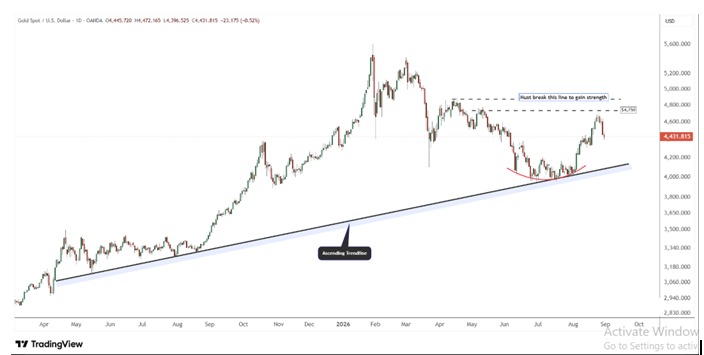
From a technical perspective, gold has recently pulled back from the $4,750 resistance area toward the $4,400 region. However, the broader bullish structure remains intact as price continues to trade above a major ascending trend line that has acted as support in recent months. Holding this rising trend line would help preserve the underlying positive structure, while a decisive break below it could signal deeper downside risk.
Overall, gold faces a mixed outlook in the near term. Hawkish Fed expectations, stronger rate-hike bets and elevated oil prices could continue to weigh on the metal, while persistent US-Iran tensions may provide safe-haven support. A sustained break above $4,750 could revive bullish momentum, whereas renewed weakness toward the ascending trend line would make that support zone increasingly important for the next directional move.