
Gold prices extended their losses on Wednesday, dropping below the $3,800-per-ounce level and nearing fresh 14-month lows. The decline was driven by increasingly hawkish signals from the Federal Reserve and persistent inflationary pressures, which strengthened market expectations of further interest-rate hikes. Meanwhile, the U.S. Dollar Index edged 0.1% higher to 103.65, adding further pressure on dollar-denominated precious metals.
Bullion settled 0.2% lower in the previous session, marking its weakest closing level since September 2025. St. Louis Fed President Alberto Musalem suggested that several more interest-rate increases may be needed before spring, while New York Fed President John Williams stressed the need for further progress in bringing inflation back to the Fed’s 2% target. These hawkish remarks reinforced expectations of tighter monetary policy.
Gold has lost more than a quarter of its value since the U.S.–Iran war began in late February. Although geopolitical tensions typically support safe-haven demand, the conflict has driven energy prices higher, intensifying inflationary pressures and raising expectations of further central bank rate hikes.
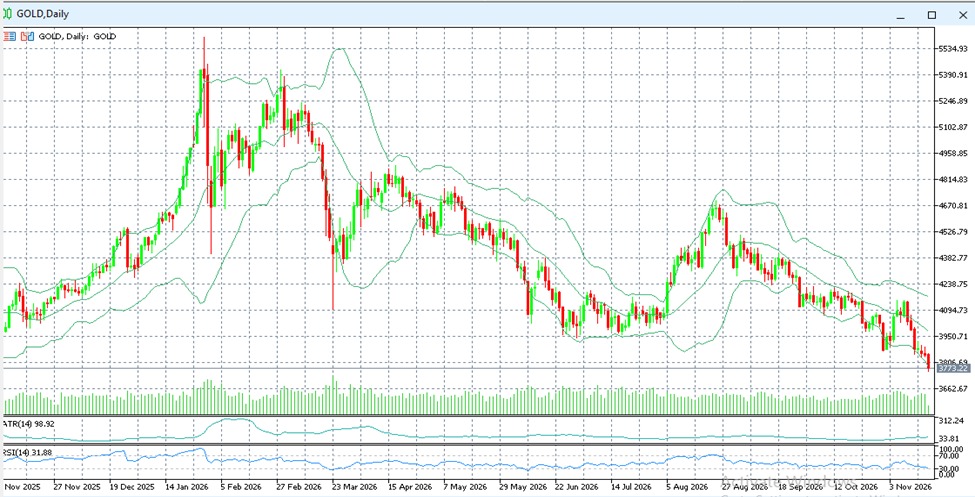
Markets are increasingly pricing in 25-basis-point Fed rate increases in December and January, followed by another potential hike by April. These expectations have strengthened the outlook for higher interest rates, reducing the attractiveness of non-yielding assets such as gold.
Meanwhile, the 10-year U.S. Treasury yield is approaching its longest sustained period above 5% in nearly two decades as investors prepare for higher borrowing costs. Rising bond yields make interest-bearing assets more attractive relative to gold, adding further downward pressure on bullion prices.
Investors are awaiting the release of minutes from the Federal Reserve’s October meeting on Wednesday for further clues about the future policy direction. Meanwhile, Fed Chair Kevin Warsh avoided direct comments on interest rates earlier this week, focusing instead on scenarios surrounding AI’s potential impact on the economy.
ANZ analysts noted that bargain buying could provide some support to gold following its recent selloff. However, expectations of further Fed tightening and a possible recovery in equities after the technology-led decline could divert investment flows away from the precious metal.
The bank maintains its base-case forecast of 25-basis-point rate increases in December, January and March, while not ruling out a larger 50-basis-point hike next month. With markets already pricing in around 80 basis points of tightening, additional rate increases could intensify gold’s near-term correction.
Despite the short-term pressure, ANZ remains positive on gold’s medium- to long-term outlook, viewing the recent weakness as temporary. Political gridlock and uncertainty surrounding government funding, debt negotiations and fiscal policy could strengthen gold’s appeal as a portfolio diversifier. The bank expects renewed institutional and retail demand to establish support near $3,600 an ounce, with prices potentially reaching $4,800 in 2027.