
The Euro (EUR) experienced modest gains against the US Dollar (USD) on Wednesday. Despite the slight increase, the currency pair remains near the lower end of the recent trading range, hovering around 1.1750. This comes as hopes for a positive resolution to the US-Iran peace negotiations diminish.
US President Trump has extended the ceasefire unilaterally until negotiations with Iran conclude. However, he continues to enforce the blockade on the Strait of Hormuz, a move considered by Iran as an act of war and a violation of the fragile ceasefire agreement.
Iran has kept its intentions regarding participation in upcoming peace talks uncertain. Meanwhile, the Islamic Revolutionary Guard has raised its rhetoric, warning of “crushing blows” against what they describe as “the enemy’s remaining assets,” according to Iran’s Tasnim news Agency, cited by The Guardian.
On Tuesday, the EUR/USD pair fell nearly 0.4%, weighed down by negative news from the Middle East and a stronger US Dollar. Additionally, upbeat US Retail Sales data and a compelling testimony by Fed Chair Nominee Kevin Warsh during Senate confirmation hearings provided further support for the US currency.
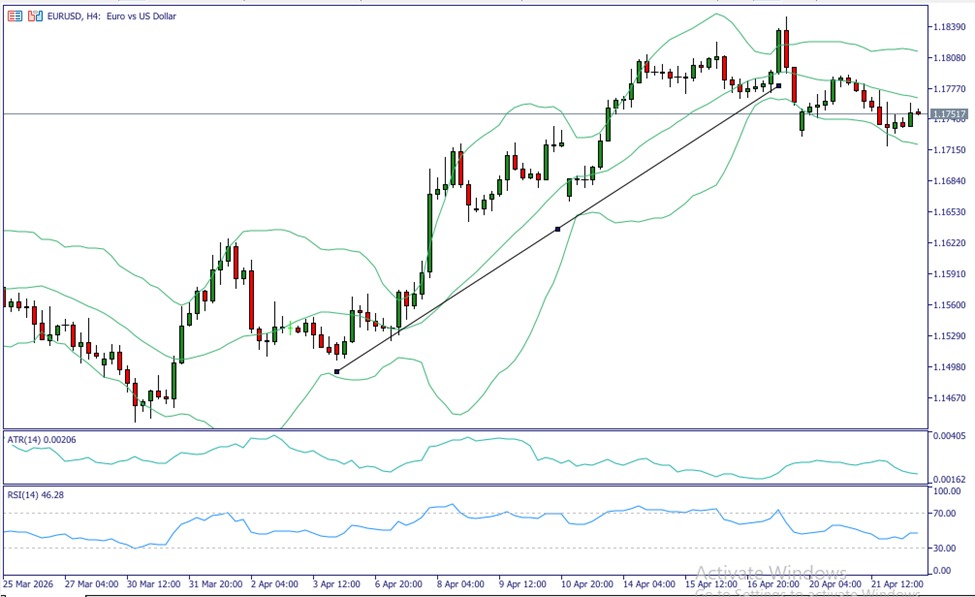
From a technical perspective, the bullish trend established since late March appears to be losing momentum. The recent price action suggests that the upward move may be stalling, with technical indicators pointing towards a neutral or bearish outlook.
On the 4-hour chart, the Relative Strength Index remains below the 50 level, indicating waning buying pressure. Currently, EUR/USD is trading just below 1.1760, limiting gains and keeping the weekly highs near 1.1790 out of reach. The April 17 high around 1.1850 seems unlikely to be tested in the immediate future.
Support levels are seen at Tuesday’s low near 1.1720. If this level gives way, the upward trend line from the March 30 low, now around 1.1700, along with the mid-April lows between 1.1645 and 1.1675, will come into focus as key areas to watch.